

Aged Domain vs Expired Domain – Aged domains are domains purchased at auction before they’re deleted, keeping their original registration date and authority intact. Expired domains are domains that weren’t bought at auction, got deleted, and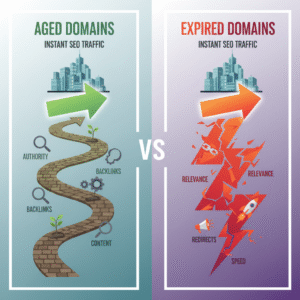 had their registration date reset to zero. Aged domains offer immediate SEO value with established trust, while expired domains carry variable quality and potential penalties.
The difference matters because aged domains preserve all their backlinks with matching registration dates, while expired domains lose their age verification, making search engines question why a “new” domain has backlinks from 5 years ago.
For competitive SEO, aged domains win by delivering rankings 12-18 months faster – and they’re the fastest way to get instant SEO traffic that you can redirect to any new domain you’re building
👉 Get expert domain vetting before you buy — contact me
Quick Decision Guide
Buy Aged Domains (Auction Domains) If:
- You need instant SEO traffic without waiting months for rankings
- You want to 301 redirect aged domain traffic to your new domain for immediate authority transfer
- Your project budget is $500+ and you want proven authority
- You’re building authority sites or affiliate sites for serious income
- You want domains that typically include backlinks from premium sources worth hundreds per link
- You can’t afford to wait 2+ years for new domain sandbox periods
- You’re in YMYL niches (health, finance, legal) requiring maximum trust
Buy Expired Domains If:
- You’re testing low-competition micro-niches with weak competitors
- Your budget is under $100 and you accept high failure risk
- You have time to vet 20-50 domains to find 1-2 decent ones
- You’re okay with 6-12 month delays while Google re-evaluates the domain
- You’re building throwaway test sites, not long-term brands
👉 Get expert domain vetting before you buy — contact me
Here’s the Bottom Line
Aged domains consistently outperform expired domains for serious SEO projects because they preserve the exact authority signals that search engines trust – unbroken registration history, verified backlink timelines, and proven crawl patterns that expired domains lose during deletion. If you’re building for real revenue in competitive spaces, aged domains aren’t optional extras – they’re the foundation that determines whether your project ranks in 12 months or struggles for 3+ years.
The higher upfront cost pays for itself through faster rankings, lower penalty risks, and backlink portfolios that would cost tens of thousands to build manually. Plus, aged domains often come with existing traffic you can immediately redirect to any new domain you’re building, giving you instant SEO visitors while your new site builds authority.
Smart domain buyers focus on finding quality aged domains with clean histories and relevant backlinks rather than gambling on cheap expired alternatives where 80% fail due to hidden penalties, timeline mismatches, or market-rejected quality issues.
Aged vs Expired Domains: Comparison Table
| Factor | Aged Domains | Expired Domains | Winner |
|---|---|---|---|
| Instant Traffic Potential | Often receive existing organic traffic that can be 301 redirected to new domains for immediate visitors | May have residual traffic but WHOIS reset creates uncertainty about traffic stability | Aged Domains |
| Backlink Advantage | Typically include backlinks from premium sources (major publications, .gov, .edu sites) where individual links can cost hundreds to acquire through outreach. Link power transfers with full authority | Same backlinks may exist but temporal mismatch (old links, new registration date) creates algorithm uncertainty about link authenticity | Aged Domains |
| Registration Date | Original date preserved (e.g., registered 2015, still shows 2015) | WHOIS resets completely – shows 2025 even if domain existed since 2015 | Aged Domains |
| Ranking Speed | Already indexed – content can rank immediately, no sandbox | 2-4 month re-evaluation period, may face sandbox effects | Aged Domains |
| Quality Level | First-tier – serious buyers grabbed these at auction | Second-tier – nobody wanted them at auction | Aged Domains |
| Price | $500-$5,000 based on competitive bidding | $10-$20 standard registration | Expired (upfront cost) |
| Penalty Risk | Low – continuous history, less likely abandoned due to penalties | High – often dropped because of penalties or spam | Aged Domains |
| Trust Signals | Trust Flow 30-50+, validated authority | Unknown – may have hidden penalties in Google’s database | Aged Domains |
👉 Get expert domain vetting before you buy — contact me
Aged vs Expired: Authority Quality
Aged Domain Specifications
Instant Traffic Capability: Many quality aged domains still receive organic search traffic from existing rankings when you purchase them. This traffic represents immediate value you can capture by either building content on the aged domain directly or using 301 redirects to send that traffic to any new domain you’re building. The redirect strategy allows you to start getting SEO visitors on day one while your new domain builds its own authority – essentially borrowing the aged domain’s traffic until your new site ranks independently.
WHOIS Date Preservation: Aged domains bought at auction keep their original registration date. To keep the WHOIS creation date, you must buy before the domain reaches pending delete.
This means a domain registered in 2012 still shows 2012 – proving to Google that backlinks from 2013-2024 were built legitimately over time.
Premium Backlink Profiles: Aged domains often have backlinks from sites like Wall Street Journal, New York Times, government sites, and universities that you can’t get through regular outreach. Individual links from these sources can cost hundreds to thousands of dollars if acquired through legitimate sponsored content or PR campaigns.
Quality aged domains frequently include dozens of these premium placements, representing substantial existing authority.
No Sandbox Period: Aged domains don’t face sandbox problems because they’re already indexed – new content can rank immediately. New domains wait 3-6 months. Expired domains with reset dates may face re-evaluation delays of 2-4 months.
Crawl Priority: Google’s crawlers trust aged domains and index new content within days instead of weeks. This crawl priority comes from years of consistent updates that trained the algorithm to check these domains frequently.
👉 Get expert domain vetting before you buy — contact me
Expired Domain Limitations
Traffic Instability: While some expired domains may retain residual traffic after WHOIS reset, the traffic patterns become unpredictable.
The age reset can trigger ranking re-evaluation where Google questions whether current rankings should continue, potentially causing traffic drops weeks or months after purchase.
This instability makes expired domains unreliable for immediate traffic strategies or 301 redirect plans.
WHOIS Reset Problem: When domains reach pending delete, the WHOIS record resets completely with a new creation date. Now you have a domain showing 2025 registration but backlinks from 2018.
Google sees this mismatch and may discount those old links because the timeline doesn’t make sense.
Market Rejection Signal: If thousands of domain investors saw a domain at auction and nobody bid on it, that’s a red flag. Domains that don’t get picked up at auction typically weren’t good quality. The expired pool is basically rejected inventory.
Hidden Penalties: Expired domains can inherit hidden penalties from previous owners who used spam tactics or black-hat SEO. These penalties don’t show up in backlink tools but stay in Google’s database. Many domains get abandoned because of penalties, not forgetfulness.
Backlink Context Issues: Even if expired domains keep their backlinks, the value drops when your new content doesn’t match the old topic. A domain with veterinary backlinks repurposed for crypto loses link relevance because the anchor text and linking page context don’t match your content.
👉 Get expert domain vetting before you buy — contact me
The 301 Redirect Strategy: Instant Traffic to Any Domain
One of the most powerful uses for aged domains is the 301 redirect strategy – buying an aged domain with existing traffic and immediately redirecting it to your new domain. This gives you instant SEO visitors on day one while your new domain builds its own authority. Here’s how it works:
Step 1 – Find Aged Domain with Traffic: Look for aged domains that still show organic traffic in tools like Ahrefs or SEMrush.
Domains receiving even 100-500 monthly visitors represent valuable traffic you can redirect immediately.
Step 2 – Verify Topical Relevance: The aged domain’s topic should match your new domain’s focus. Redirecting a fitness domain to a finance site won’t work because the backlink context and visitor intent don’t align. Keep topics closely related for maximum benefit.
Step 3 – Set Up 301 Redirect: Once you own the aged domain, create a 301 redirect pointing the entire domain to your new site. This tells search engines “this domain permanently moved here” and transfers both the traffic and authority signals.
Step 4 – Monitor Traffic Transfer: Most redirected traffic transfers within 2-4 weeks. You’ll see immediate visitors from the aged domain’s existing rankings, plus the authority boost helps your new domain rank faster for its own keywords.
The Advantage: Instead of waiting 6-12 months for your new domain to escape sandbox and start ranking, you get instant traffic from day one while building long-term rankings. It’s the fastest way to validate business models, generate immediate revenue, and fund your SEO efforts while your new site matures.
👉 Get expert domain vetting before you buy — contact me
Where Expired Domains Fail
Age Reset Kills Trust Verification: Expired domains get completely reset WHOIS records. This creates an obvious problem: backlinks from 2016-2022 pointing to a domain that shows 2025 registration. Google’s algorithm could easily say “backlinks older than registration date = discounted.” Aged domains don’t have this problem – their registration date matches their backlink history perfectly.
Nobody Wanted Them at Auction: Thousands of professional domain buyers monitor auctions daily. When a domain goes through the entire auction without a single bid and ends up expired, that’s the market saying “this isn’t worth buying.” You’re gambling on finding value that experts already rejected.
Research Time Costs More Than Savings: Expired domains cost $10-$20 but require 20-40 hours of vetting per domain. At $50/hour, that’s $1,000-$2,000 in time to find one good domain. That “cheap” expired domain just cost more than a $500-$2,000 aged domain that came with market validation.
Penalty Inheritance: Expired domains require intense vetting to ensure they’re not carrying toxic backlinks or hidden Google penalties.
Even after checking tools and Wayback Machine, penalties can hide in Google’s internal records and kill your rankings 6 months after you’ve invested in content.
Price vs Value: The Real Cost
Aged Domain ROI: A $3,000 aged domain with Trust Flow 40 and 500 quality backlinks replaces what could cost $30,000-$50,000 in professional link building and 2-3 years of outreach work. If your site hits $5,000/month revenue 18 months faster than a new domain, that’s $90,000 extra revenue. The $3,000 investment delivered 30x returns.
Expired Domain Hidden Costs: $15 registration looks cheap until you factor in:
- 30 hours vetting time = $1,500 (at $50/hr value)
- Testing 10 domains to find 1 good one = $150 + development waste
- 6-12 month ranking delays = lost revenue
- Penalty risks = potential total loss
Competition Determines Strategy: In competitive niches (finance, health, tech), aged domains are mandatory. The top 10 results all have Domain Authority 40-60+. An expired domain with DA 20 won’t compete no matter how good your content is.
👉 Get expert domain vetting before you buy — contact me
When Each Type Works
Aged Domains Win For:
- Getting instant SEO traffic through existing rankings or 301 redirects
- Competitive niches where page 1 competitors have DA 40+
- Affiliate sites targeting products with existing competition
- Authority sites requiring 2-3 year content investments
- YMYL topics (health, finance) needing maximum trust
- Any project where immediate traffic or 12-18 month faster rankings justify $2,000-$5,000 cost
Expired Domains Work For:
- True micro-niches where competitors have DA 15-20
- Portfolio testing of 10-20 sites accepting 80% failure rate
- Learning domain evaluation before buying aged domains
- Budget projects under $500 total investment
- Low-stakes experiments where failure is acceptable
Vetting Checklist
For Any Domain:
- Check Trust Flow (30-50+ is good, 50+ is excellent)
- Verify Trust Flow and Citation Flow are within 15 points of each other
- Look for backlinks from authoritative sites you couldn’t easily acquire yourself
- Check Wayback Machine for spam, adult content, or PBN usage
- Confirm topic consistency – tech domains should have tech backlinks, not random mixed topics
- Verify existing traffic in Ahrefs/SEMrush if planning redirect strategy
Extra for Expired Domains:
- Verify backlink dates match previous WHOIS registration periods
- Check if traffic dropped suddenly before expiration (penalty sign)
- Search domain name in quotes to find spam reports or penalty discussions
- Confirm the domain wasn’t listed on malware or spam databases
The Domain Lifecycle Explained
Understanding when to buy matters:
Days 0-30: Domain expires, enters grace period. Original owner can renew. Auctions start listing it. Buy here = aged domain with original date preserved.
Days 31-60: Redemption period. Owner can still recover it for a fee. Auctions continue. Still safe to buy as aged domain.
Days 61-65: Pending delete. Nobody can buy it. It’s locked.
Day 66+: Domain deletes, WHOIS resets completely. Returns to registration pool. Buy here = expired domain with new registration date.
To keep the original WHOIS date, buy before pending delete through auctions. That’s the only way to get an aged domain.
Which Should You Choose?
Choose aged domains if: You need instant SEO traffic through existing rankings or 301 redirects, you’re serious about SEO, competing in normal or competitive niches, building for income not testing, and can invest $500-$5,000 upfront. The ranking speed, proven backlinks, instant traffic potential, and lower risk make them mandatory for real business projects.
Choose expired domains if: You’re testing micro-niches with near-zero competition, building a portfolio of 10+ sites where 2-3 successes justify total investment, or learning domain evaluation skills before investing larger amounts. Accept that 80% will fail.
Bottom line: For most SEO projects targeting actual revenue, aged domains deliver better ROI through faster rankings, instant traffic potential, and higher success rates. The upfront cost is higher but the time-to-revenue is immediate to 12 months faster, making them cheaper when you calculate opportunity cost and total project success probability.
FAQ
What’s the main difference between aged and expired domains?
Aged domains are bought at auction before deletion, keeping their original registration date and full authority. Expired domains completed deletion, got their registration date reset to zero, and returned as “new” domains despite having old backlinks – creating timeline inconsistencies that may reduce link value.
Can I redirect an aged domain’s traffic to my new website?
Yes, this is one of the most powerful strategies. Buy an aged domain with existing traffic, set up a 301 redirect to your new domain, and you’ll start receiving instant SEO visitors while your new site builds its own authority. This works best when the aged domain’s topic closely matches your new site’s focus for maximum relevance and authority transfer.
Do expired domains still pass link value after the reset?
The backlinks technically remain, but the WHOIS reset creates a new registration date that doesn’t match backlink ages. Google could discount links older than the registration date since the timeline doesn’t verify. Aged domains avoid this by maintaining continuous registration matching their backlink history.
Why are aged domains $500-$5,000 vs expired at $10-$20?
Aged domains go through competitive auctions where experienced buyers validate quality through bidding. The price reflects proven value including existing traffic, clean backlink profiles, and preserved authority. Expired domains cost registration fees because nobody wanted them at auction – they’re rejected inventory. The “cheap” price signals market rejection, not a bargain.
Can aged domains really skip the Google sandbox?
Aged domains are already indexed and don’t have sandbox problems – content can rank immediately. New domains face 3-6 month sandbox delays regardless of content quality. Expired domains may face 2-4 month re-evaluation periods despite inherited backlinks.
Are expired domains safe after Google’s spam updates?
Expired domains can inherit hidden penalties from previous owners’ spam tactics that remain in Google’s database. Many domains get abandoned due to penalties, not forgetfulness. Aged domains have cleaner histories because domains with penalties don’t get renewed through expensive auction purchases.
Which gives faster rankings in competitive niches?
Aged domains rank 12-18 months faster in competitive spaces through immediate authority, no sandbox delays, and verified backlink timelines. They also often come with existing traffic you can leverage immediately. Expired domains face re-evaluation periods and timeline verification issues that delay full authority recognition, making them uncompetitive against established sites with continuous trust histories.
👉 Get expert domain vetting before you buy — contact me
What to Check Before You Rely on This Article
- Confirm Clean History: Ensure the domain is not penalized or spammy.
- Inspect Backlinks & Past Usage: Use Wayback Machine, Ahrefs, Moz, or SEMrush to evaluate backlink profiles, anchor text, and domain authority.
- Match Niche Relevance: Authority may exist, but Google may treat unrelated backlinks as irrelevant.
- Monitor Algorithm Changes: Domain age alone is not enough; quality content, user experience, and regular updates are essential.
- Plan Long-Term: Even with an aged domain, a full SEO strategy (content, UX, backlinks) is critical for success.
👉 Get expert domain vetting before you buy — contact me
How I’d Use This (if I were you)
- Use this guide to prioritize aged domains over expired domains, but only after deep manual vetting.
- Combine domain acquisition with a strong content, on-site SEO, and outreach strategy.
- Do not rely solely on domain history; treat it as one lever among many.
- Monitor post-launch traffic and indexing to catch any residual penalties or drops early.
👉 Get expert domain vetting before you buy — contact me
