
Paid Ads vs SEO – Paid ads are advertising placements you purchase for immediate visibility, paying per click or impression with traffic stopping the moment your budget runs out. SEO is the process of optimizing your website to rank organically in search results, building traffic that compounds over time without per-click costs. Paid ads offer speed, while SEO delivers long-term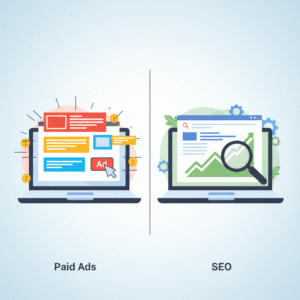 value.
The difference matters because paid ads create a dependency where you are essentially renting traffic, while SEO builds an asset you own. A business spending $5,000 monthly on ads generates zero traffic the day they stop paying. A business investing that same $5,000 monthly into SEO builds rankings that continue delivering traffic for years.
For sustainable business growth, SEO wins by delivering traffic that compounds month over month. Combining SEO with aged domain strategies is the fastest way to escape the paid ads treadmill while building lasting organic authority.
👉 Get expert SEO strategy guidance – contact me
Quick Decision Guide
Choose SEO If:
- You want traffic that grows over time without increasing spend
- You are building a business for long-term success, not quick flips
- Your budget allows 6 to 12 months of investment before expecting major returns
- You want to own your traffic source rather than rent it
- You are in competitive industries where trust and authority matter
- You can invest in aged domains to accelerate your SEO timeline
Choose Paid Ads If:
- You need immediate traffic for a time-sensitive offer or launch
- You are testing new products or markets before committing long-term
- Your margins support ongoing ad spend indefinitely
- You have landing pages optimized for immediate conversions
- You are supplementing SEO efforts during the initial ranking period
👉 Get expert SEO strategy guidance – contact me
Here’s the Bottom Line
SEO consistently outperforms paid ads for businesses building lasting value because organic traffic compounds while paid traffic resets to zero every month. The math is simple: a website ranking on page one receives traffic around the clock without additional spend, while paid ads require continuous investment just to maintain the same visitor numbers.
The higher upfront investment in SEO pays for itself through traffic that grows rather than depletes. Smart businesses use paid ads strategically for launches and testing, while building SEO as their primary traffic foundation. Combining SEO with aged domain acquisition accelerates this process dramatically, cutting the typical timeline to achieve meaningful organic rankings.
The smartest approach treats paid ads as a bridge strategy while SEO matures, then shifts budget toward content and authority building once organic traffic takes over.
Paid Ads vs SEO: Comparison Table
| Factor | SEO | Paid Ads | Winner |
|---|---|---|---|
| Traffic Longevity | Rankings can deliver traffic for years after initial investment stops | Traffic stops immediately when ad spend stops | SEO |
| Cost Structure | Upfront investment with diminishing costs over time as rankings establish | Ongoing cost that increases as you scale or competition rises | SEO |
| Time to Results | 3 to 12 months for new domains, faster with aged domains | Immediate, traffic starts within hours of campaign launch | Paid Ads |
| Click-Through Rates | Organic results receive higher trust and click rates from users | Ad blindness reduces engagement, especially among experienced users | SEO |
| Scalability | Traffic scales with content and rankings without proportional cost increase | Scaling requires proportionally higher spend | SEO |
| Trust Signals | Organic rankings signal credibility and authority to users | Users recognize ads and may trust them less | SEO |
| Competition Impact | Competitors cannot directly outspend you for your rankings | Competitors can bid higher and push you down instantly | SEO |
| Learning Curve | Requires understanding of technical SEO, content, and link building | Requires understanding of ad platforms, targeting, and optimization | Tie |
SEO Advantages Explained
Compounding Traffic Growth
SEO traffic compounds over time. A single well-optimized article can rank for dozens of related keywords, attracting visitors month after month without additional investment. As your site builds authority, new content ranks faster and for more competitive terms.
This compounding effect means year two of SEO typically delivers far more traffic than year one, while year two of paid ads requires the same or higher spend for equivalent results.
Higher Trust and Click-Through Rates
Users trust organic search results more than advertisements. Organic listings consistently receive more clicks than paid placements for the same search queries. This trust factor becomes especially important in industries where credibility matters, such as health, finance, and professional services.
Asset Building vs Expense
Every dollar spent on SEO builds an asset you own. Content, backlinks, and domain authority remain with your business. Every dollar spent on paid ads is an expense that provides no lasting value once the campaign ends. This fundamental difference affects how each strategy impacts your business valuation and long-term sustainability.
Protection from Bid Wars
In paid advertising, competitors can outbid you at any time, instantly increasing your costs or pushing you off the page entirely. SEO rankings require competitors to invest significant time and effort to overtake you, providing more stable positioning and predictable traffic.
Where Paid Ads Fall Short
Traffic Dependency Creates Vulnerability: The moment you stop paying, your traffic disappears completely. This creates a dangerous dependency where your business cannot survive without continuous ad spend. During economic downturns or cash flow challenges, businesses reliant on paid ads face immediate revenue collapse while SEO-focused businesses continue receiving organic traffic.
Increasing Costs Over Time: Paid advertising costs tend to rise as platforms mature and competition increases. Keywords that were affordable a few years ago may cost significantly more today. This inflation erodes margins and requires either higher prices or reduced profitability. SEO costs, by contrast, typically decrease over time as established rankings require less maintenance than initial acquisition.
Ad Fatigue and Blindness: Users increasingly ignore advertisements, a phenomenon called ad blindness. This means you are paying for impressions that generate fewer and fewer clicks over time. Organic results do not suffer from this fatigue because users actively seek them out.
Platform Risk: Your paid advertising success depends entirely on platforms you do not control. Algorithm changes, policy updates, or account suspensions can eliminate your traffic overnight with no recourse. SEO diversifies your traffic sources and reduces dependency on any single platform.
The Aged Domain Advantage: Accelerating SEO Results
One of the biggest objections to SEO is the time required to see results. New domains typically face a 6 to 12 month period before achieving meaningful rankings, during which paid ads may seem like the only option for traffic. However, aged domains eliminate this waiting period almost entirely.
How Aged Domains Accelerate SEO:
Aged domains purchased at auction before deletion retain their original registration date, established backlink profiles, and existing authority signals. This means you can start ranking new content within weeks rather than months, making SEO competitive with paid ads for speed while maintaining all the long-term advantages.
The Bridge Strategy:
Smart marketers use paid ads as a temporary bridge while their SEO matures, then shift budget to content and link building once organic traffic takes over. Using an aged domain shortens this bridge period dramatically, reducing total paid ad spend while accelerating the transition to sustainable organic traffic.
Combined ROI:
An aged domain that eliminates months of waiting represents a fraction of what you would spend on paid ads during that same period. If you are spending thousands monthly on ads, the savings during the acceleration period alone justify the domain investment, plus all future savings from organic traffic replacing paid traffic.
When to Use Each Strategy
SEO Wins For:
- Building long-term brand authority and credibility
- Content-driven businesses like blogs, media sites, and information products
- Local businesses wanting to dominate geographic searches
- E-commerce sites with large product catalogs
- Any business where customer lifetime value justifies longer acquisition timelines
- Businesses using aged domains to accelerate organic growth
Paid Ads Work For:
- Product launches requiring immediate visibility
- Time-sensitive promotions or seasonal offers
- Market testing before committing to full SEO investment
- Retargeting existing website visitors
- Supplementing organic traffic during SEO ramp-up period
- Highly specific targeting requirements SEO cannot achieve
The Real Cost Comparison
SEO Investment:
Monthly investment in content creation, technical optimization, and link building accumulates into an asset that delivers returns for years. A site built over 24 months of SEO investment continues generating traffic in months 25, 26, and beyond without proportional ongoing costs.
Paid Ads Investment:
The same monthly budget in paid ads provides traffic only during active campaigns. Month 25 requires the same spend as month 1 for equivalent traffic. There is no accumulated value, no owned asset, and no leverage from previous investment.
Hybrid Approach:
The most effective strategy combines both. Use paid ads for immediate needs and market testing while building SEO as your primary traffic foundation. As organic traffic grows, gradually shift budget from ads to content and authority building.
👉 Get expert SEO strategy guidance – contact me
Which Should You Choose?
Choose SEO if: You are serious about building a sustainable business with traffic you own. The upfront investment and patience required pay off through compounding organic traffic that grows year over year. Combining SEO with aged domain acquisition eliminates the primary disadvantage (time to results) while preserving all the long-term benefits.
Choose Paid Ads if: You need immediate traffic for time-sensitive offers, you are testing new markets before committing, or you are using them as a bridge while SEO matures. Accept that this is an ongoing expense rather than an investment in a lasting asset.
Bottom line: For most businesses building for long-term success, SEO delivers better ROI through traffic that compounds rather than depletes. Paid ads serve important tactical purposes but should supplement rather than replace organic traffic strategies. The smartest operators use aged domains to accelerate their SEO timeline while minimizing paid ad dependency.
FAQ
How long does SEO take to show results compared to paid ads?
Paid ads deliver traffic within hours of launching campaigns. SEO on new domains typically requires 6 to 12 months for meaningful rankings. Aged domains with established authority can rank new content within weeks, making SEO speed competitive with paid ads while maintaining long-term advantages.
Is SEO really free traffic?
SEO requires investment in content creation, technical optimization, and link building. However, once rankings are achieved, traffic continues without per-click costs. Unlike paid ads where every visitor costs money, organic visitors arrive without additional spend once initial investment establishes rankings.
Can I do both paid ads and SEO simultaneously?
Yes, this hybrid approach is often optimal. Use paid ads for immediate traffic needs and market testing while building SEO for long-term sustainability. As organic traffic grows, shift budget from ads toward content and authority building to accelerate SEO results further.
Why do businesses stay dependent on paid ads?
Many businesses prioritize immediate results over long-term value, or lack the patience and expertise for effective SEO. This creates a costly dependency where traffic requires continuous payment. Breaking this cycle requires investing in organic strategies while using aged domains to accelerate the transition timeline.
Do aged domains really help SEO rank faster?
Yes. Aged domains purchased at auction retain their original registration date, established backlinks, and authority signals. This eliminates the sandbox period new domains face, allowing new content to rank within weeks rather than months. This acceleration makes SEO competitive with paid ads for speed.
Which strategy is better for small businesses with limited budgets?
SEO delivers better long-term ROI for limited budgets because the investment compounds over time. A small business investing monthly in SEO builds an asset worth significantly more after a year, while the same investment in paid ads provides only temporary traffic with no lasting value.
